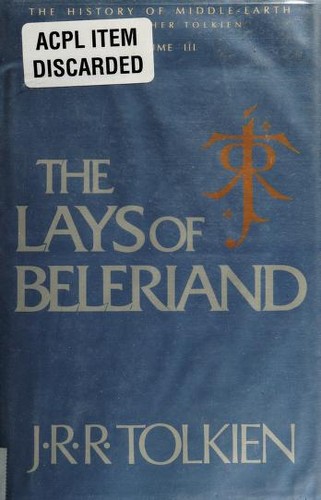
- Fantasy poetry, English, Poetry, Middle Earth (Imaginary place), English Fantasy poetry
This is the third volume of the History of Middle-earth, which comprises here-tofore unpublished manuscripts that were written over a period of many years before Tolkien's Simlarillion was published. Volumes 1 and 2 were the Book of Lost Tales, Part One and The Book of Lost Tales, Part Two. Together, these volumes encompass an extraordinarily extensive body of material ornamenting and buttressing what must be the most fully realized world ever to spring from a single author's imagination. "I write alliterative verse with pleasure," wrote J.R.R. Tolkien in 1955, "though I have published little beyond the fragments in The Lord of the Rings, except The Homecoming of Beorhtnoth." The first of the poems in The Lays of Beleriand is the previously unpublished Lay of the Children of Hurin, his early but most sustained work in the ancient English meter, intended to narrate on a grand scale the tragedy of Turin Turambar. It was account of the killing by Turin of his friend Beleg, as well as a unique description of the great redoubt of Nargothrond. The Lay of the Children of Hurin was supplanted by the Lay of Leithian, "Release from Bondage", in which another major legend of the Elder Days received poetic form, in this case in rhyme. The chief source of the short prose tale of Beren and Luthien is The Silmarillion. This, too, was not completed, but the whole Quest of the Silmaril is told, and the poem breaks off only after the encounter with Morgoth in his subterranean fortress. Many years later, when The Lord of the rings was finished, J.R.R. Tolkien returned to the Lay of Leithian and started on a new version, which is also given in this book. Accompanying the poems are commentaries on the evolution of the history of the Elder Days, which was much developed during the years of the composition of the two Lays. Also included is the notable criticism in detail of the Lay of Lethian by C.S. Lewis, Tolkien's friend and colleague, who read the poem in 1929. By assuming that this poem is actually a fragment from a past lost in history, Lewis underlined the remarkable power of its author's imaginative talents and academic competence.
Log it
Sign in to log this.
Character
Grave, epic, richly built and earnest.
- gravecomic
- intimateepic
- sparerichly built
- earnestironic
- contemplativerelentless
Who loves it, who doesn't
No profiled raters yet.
Ask the title
A yes-or-no question, answered from what people wrote here, on TMDB and on Wikipedia. Never made up.
Reviews
No reviews yet.
About the book
- First published
- 1985
- Pages
- 393
- Publisher
- Houghton Mifflin Company, Grafton, HarperCollins
- Editions
- 15
- Language
- English, Spanish
- ISBN
- 9780007365272
Where to read
Libraries first: a card gets you most books for nothing. Each opens that service’s page for this title.
On Open Library, 3 have read it and 28 want to.
- Fantasy poetry, English
- Poetry
- Middle Earth (Imaginary place)
- English Fantasy poetry
- Fiction, science fiction, general
- British and irish fiction (fictional works by one author)
- Fiction, fantasy, general
- Middle earth (imaginary place), fiction
- Tolkien, j, r. r. (john ronald ruel), 1892-1973
- Textual Criticism
- English poetry
- Texts
John Ronald Reuel Tolkien (1892-1973) was a major scholar of the English language, specialising in Old and Middle English. Twice Professor of Anglo-Saxon (Old English) at the University of Oxford, he also wrote a number of stories, including most famously The Hobbit (1937) and The Lord of the Rings (1954-1955), which are set in a pre-historic era in an invented version of the world which he called by the Middle English name of Middle-earth. This was peopled by Men (and women), Elves, Dwarves, Trolls, Orcs (or Goblins) and of course Hobbits. He has regularly been condemned by the Eng. Lit. establishment, with honourable exceptions, but loved by literally millions of readers worldwide. In the
Similar in taste
Closest on the same fourteen dimensions, from everything scored on Tastebuds Other media included when they land close.
 The Silmarillion 197782% alikeBoth epic, grave, richly built.
 Season of Mists 199173% alikeBoth epic, richly built, grave.
 The war of the jewels 199472% alikeBoth epic, grave, richly built.
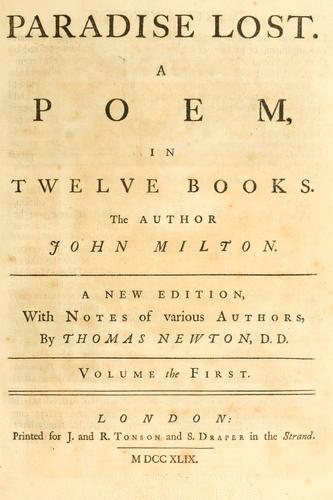 Paradise Lost 166771% alikeBoth epic, grave, earnest.
 The years of rice and salt 200271% alikeBoth epic, grave, richly built.
 A Canticle for Leibowitz 195969% alikeBoth grave, epic, contemplative.
 The Urth of the new sun 198768% alikeBoth epic, grave, richly built.
 Beren and Lúthien 201767% alikeBoth grave, epic, earnest.
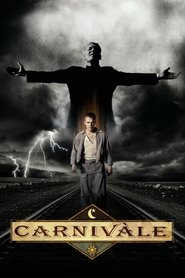 Carnivàle 200367% alikeTelevision · Both epic, grave, contemplative.
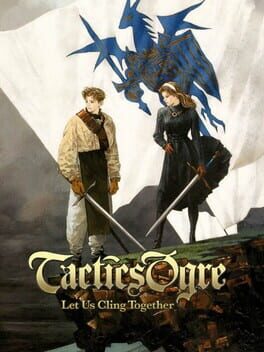 Game · Both grave, earnest, epic.