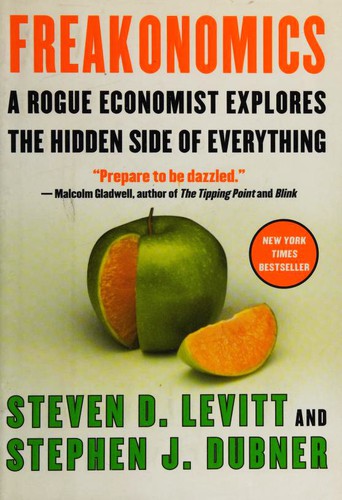
- Economics, Economics -- Psychological aspects, Economics -- Sociological aspects, Finance
*A Rogue Economist Explores the Hidden Side of Everything* Which is more dangerous, a gun or a swimming pool? What do schoolteachers and sumo wrestlers have in common? Why do drug dealers still live with their moms? How much do parents really matter? How did the legalization of abortion affect the rate of violent crime? These may not sound like typical questions for an economist to ask. But Steven D. Levitt is not a typical economist. He is a much-heralded scholar who studies the riddles of everyday life—from cheating and crime to sports and child-rearing—and whose conclusions turn the conventional wisdom on its head. Freakonomics is a ground-breaking collaboration between Levitt and Stephen J. Dubner, an award-winning author and journalist. They usually begin with a mountain of data and a simple, unasked question. Some of these questions concern life-and-death issues; others have an admittedly freakish quality. Thus the new field of study contained in this book: Freakonomics. Through forceful storytelling and wry insight, Levitt and Dubner show that economics is, at root, the study of incentives—how people get what they want, or need, especially when other people want or need the same thing. In Freakonomics, they explore the hidden side of … well, everything. The inner workings of a crack gang. The truth about real-estate agents. The myths of campaign finance. The telltale marks of a cheating schoolteacher. The secrets of the Ku Klux Klan. What unites all these stories is a belief that the modern world, despite a great deal of complexity and downright deceit, is not impenetrable, is not unknowable, and—if the right questions are asked—is even more intriguing than we think. All it takes is a new way of looking at things. Freakonomics establishes this unconventional premise: If morality represents how we would like the world to work, then economics represents how it actually does work. It is true that readers of this book will be armed with enough riddles and stories to last a thousand cocktail parties. ButFreakonomics can provide more than that. It will literally redefine the way we view the modern world. First published in the U.S. in 2005, Freakonomics went on to sell more than 4 million copies around the world, in 35 languages. It also inspired a follow-up book, SuperFreakonomics; a high-profile documentary film; a radio program, and an award-winning blog, which has been called “the most readable economics blog in the universe.” ([source][1]) [1]: http://freakonomics.com/books/
Log it
Sign in to log this.
Character
Contemporary, cool, spare and plot-driven.
- contemporarynostalgic
- cooloverwhelming
- sparerichly built
- character-ledplot-driven
- effortlessdemanding
Who loves it, who doesn't
No profiled raters yet.
Ask the title
A yes-or-no question, answered from what people wrote here, on TMDB and on Wikipedia. Never made up.
Reviews
No reviews yet.
About the book
- First published
- 2006
- Pages
- 320
- Publisher
- De Bezige Bij, Penguin Books, Penguin Books Ltd (UK)
- Editions
- 63
- Language
- English, Korean, Spanish, Portuguese
- ISBN
- 9780061234002
Where to read
Libraries first: a card gets you most books for nothing. Each opens that service’s page for this title.
On Open Library, 230 have read it and 1,108 want to.
“Anyone living in the United States in the early 1990s and paying even a whisper of attention to the nightly news or a daily paper could be forgiven for having been scared out of his skin.”
"Steven David "Steve" Levitt is a prominent American economist best known for his work on crime, in particular on the link between legalized abortion and crime rates. Winner of the 2003 John Bates Clark Medal, he is currently the Alvin H. Baum Professor of Economics at the University of Chicago, director of the Becker Center on Chicago Price Theory at the University of Chicago Graduate School of Business, and co-editor of the Journal of Political Economy published by the University of Chicago Press." - Wikipedia
Similar in taste
Closest on the same fourteen dimensions, from everything scored on Tastebuds Other media included when they land close.
 The Thursday Murder Club 202058% alikeBoth contemporary.
 Both contemporary, spare, cool.
 Sapiens 201152% alikeBoth cool, plot-driven, spare.
 The Tainted Cup 202449% alikeBoth contemporary, spare.
 Artemis 201745% alikeBoth contemporary; this one is more richly built.
 Both contemporary; this one is more character-led.
 A Good Girl's Guide to Murder 201945% alikeBoth contemporary, spare; this one is more overwhelming.
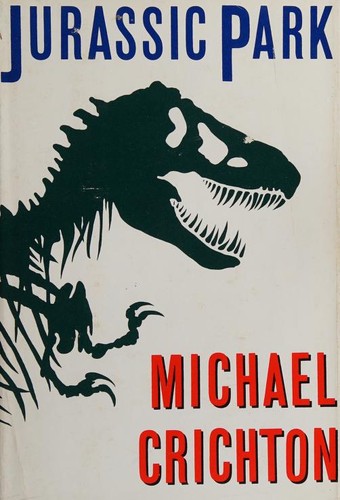 Jurassic Park 199044% alikeBoth contemporary, plot-driven; this one is more richly built.
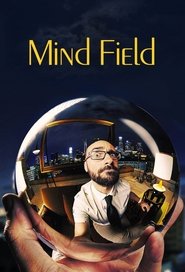 Mind Field 201770% alikeTelevision · Both spare, cool, contemporary.
 Derren Brown: Miracle 201667% alikeFilm · Both contemporary, spare, plot-driven.