
- Fiction, general, Fiction in English, Science fiction, Fiction
After reading "Last and First Men", I approached Olaf's next masterpiece, "Star Maker" ( first published in 1937), with some disbelief as to how on earth he could possibly better the span, pathos and magnanimity he had already laid out. A quick scan of the appendices yielded the impression that this book would embrace not just the tiny fragment of history that was mankind's stay in the universe, but that all history of the universe would be described, and that of other universes too. All of this in less pages than "Last and First Men"! My immediate reaction was simply, "No way, Jose" and I wondered how he was going to set about such an immense task. The vehicle used was, of course, the best man has going for him - his imagination. A contemplative man is whisked off on an imaginary journey through space and time by an ever-gathering mass consciousness. He describes how galaxies of stars formed from nebulae that were born flying apart from each other, how these cooling nebulae condensed into galaxies of stars, and how the rare occurrences of young stars that passed each other, formed planets, and how, on a few rare planets, intelligent life evolved. He shows how certain conditions inhibit the appearance of life, or intelligent life, and how certain evolutionary pathways cause life to stagnate or wipe itself out. He puts mankind's existence into perspective in both universal time and space. There are touching moments and there are exciting battles. There is both tragedy and comedy. There are uplifting victories and crushing defeats. Far from being stuffy, this book is really a very good read indeed, considering the scope of its subject. The final few short chapters really have you reading a couple of paragraphs, and then putting the book down to have a long ponder over what has just been addressed. And the book's climax leaves you with lifelong matters to mull over - one of these being, "Boy, and I thought I was pretty intelligent..."
Log it
Sign in to log this.
Character
Epic, richly built, contemplative and earnest.
- intimateepic
- sparerichly built
- contemplativerelentless
- earnestironic
- resolvedopen-ended
Who loves it, who doesn't
No profiled raters yet.
Ask the title
A yes-or-no question, answered from what people wrote here, on TMDB and on Wikipedia. Never made up.
Reviews
No reviews yet.
About the book
- Author
- Olaf Stapledon
- First published
- 1999
- Pages
- 243
- Publisher
- Cem Yayinevi, Penguin Books, Limited, Brand: Important Books
- Editions
- 77
- Language
- English
- ISBN
- 9781799291558
Where to read
Libraries first: a card gets you most books for nothing. Each opens that service’s page for this title.
On Open Library, 8 have read it and 58 want to.
“One night when I had tasted bitterness I went out on to the hill.”
Similar in taste
Closest on the same fourteen dimensions, from everything scored on Tastebuds Other media included when they land close.
 The years of rice and salt 200265% alikeBoth epic, richly built, earnest.
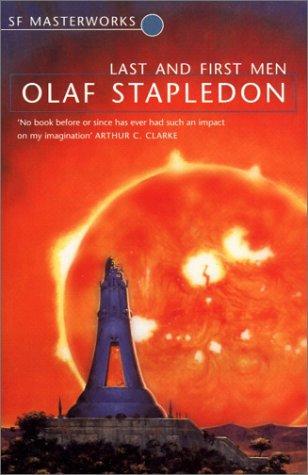 Last and First Men 193064% alikeBoth epic, richly built, earnest.
 The Bone Clocks 201464% alikeBoth epic.
 A Canticle for Leibowitz 195962% alikeBoth epic, contemplative.
 A Voyage to Arcturus 192062% alikeBoth epic, earnest, richly built.
 The Urth of the new sun 198761% alikeBoth epic, richly built.
 The Silmarillion 197759% alikeBoth epic, richly built, earnest.
 The Last Question 200759% alikeBoth epic, earnest.
 Cloud Atlas 201272% alikeFilm · Both epic, earnest, open-ended.
 Outer Wilds 201971% alikeGame · Both epic, richly built, contemplative.