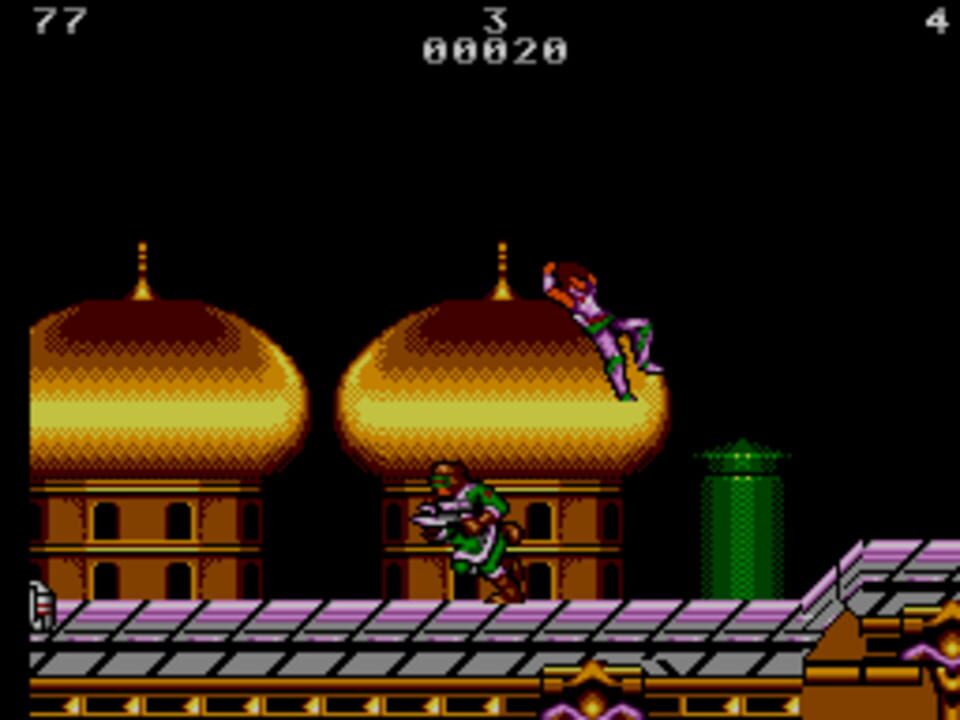
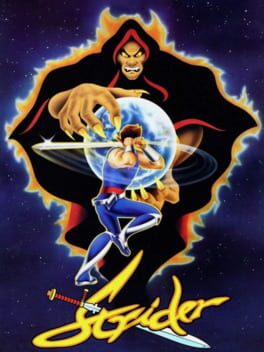
The controls of Strider consist of an eight-way joystick and two action buttons for attacking and jumping. The player controls Hiryu himself, whose main weapon is a tonfa-like plasma sword known as "Cypher". He can perform numerous acrobatic feats depending on the joystick/button combination used. Pressing the jump button while Hiryu is standing still will cause him to do a regular vertical jump, while pressing the jump button while pushing the joystick left or right will enable him to do a cartwheel jump. Hiryu can also slide under or through certain obstacles and enemies by first crouching down and then pressing the jump button. As well as his sliding move, both jumps can also be used to destroy weaker opponents. Hiryu is able to latch onto certain platforms, and climb across walls and ceilings using a metallic hook. While running down a sloped surface, Hiryu can gain enough momentum to allow him to do a longer cartwheel jump than usual. Numerous power-ups can be obtained from item boxes carried by certain enemies. These includes an extension to Hiryu's attack range that lasts for one hundred slashes, two types of health aids (represented by the kanji used to write Hiryu's name: 飛 and 飛竜), a max health extension (represented by the kanji 竜, the second character in Hiryu's name), an extra life, and a power-up that not only makes Hiryu invulnerable to attack but also increases his own attack abilities via shadow images of himself for 15 seconds.[3] Hiryu can also summon robotic companions known collectively as "options" that help him fight enemies. These consist of up to two mushroom-like droids, a saber-toothed tiger and a hawk, known individually as Option A, B and C respectively. The game has five stages: the Kazakh Soviet Socialist Republic (called "St. Petersburg" during the arcade game's attract sequence), the Siberian Wilderness, the Aerial Battleship Balrog (געלראב), the Amazonian Jungle, and the Grandmaster's lair itself, the Third Moon. Each of the stages is divided into a number of smaller sections, each with their own time limit and checkpoint location. The player has a three-point health gauge (which can be increased to five points with the health extensions. Hiryu will lose a life when either his health gauge is fully depleted, by moving him off the screen entirely (like falling into a bottomless pit) or when the game's timer reaches zero. It's Game Over when all of Hiryu's lives are lost, but the player can be given the opportunity to continue. Strider is set in a dystopian future in the year 2048, where a mysterious dictator known as the "Grandmaster" rules over the world. Hiryu, the youngest ever Super A Ranked[2] member of an organization of high-tech ninja-like agents known as the "Striders", is alone tasked with the Grandmaster's assassination. Hiryu begins his mission by infiltrating the Grandmaster's capital at the Kazakh Soviet Socialist Republic.
Log it
Sign in to log this.
Character
Plot-driven, earnest, cool and grave.
- character-ledplot-driven
- earnestironic
- cooloverwhelming
- gravecomic
- classical in formformally daring
Who loves it, who doesn't
No profiled raters yet.
Where do you stand?
Answer first; then see how everyone, and your circle, split.
“Is it too cool to love?”
Sign in to answer.
Be the first to answer.
“Would a little humor have helped?”
Sign in to answer.
Be the first to answer.
“Is this Capcom's best work?”
Sign in to answer.
Be the first to answer.
Ask the title
A yes-or-no question, answered from what people wrote here, on TMDB and on Wikipedia. Never made up.
Reviews
No reviews yet.
About the game
- Platforms
- Arcade, Sharp X68000, Commodore C64/128/MAX, ZX Spectrum, Wii, Sega Mega Drive/Genesis, Atari ST/STE, DOS, Amiga, Wii U, PlayStation, Amstrad CPC, Sega Master System/Mark III
- Developer
- Capcom, Capcom
- Publisher
- Capcom, U.S. Gold, Sega Enterprises, Ltd., Tec Toy
- Released
- March 1, 1989
- Modes
- Single player, Multiplayer
- Perspective
- Side view
IGDB rating 6.7/10 from 51 ratings.
Screenshots
Similar in taste
Closest on the same fourteen dimensions, from everything scored on Curator Co. Other media included when they land close.
 Darius Gaiden 199486% alikeBoth plot-driven, earnest, grave.
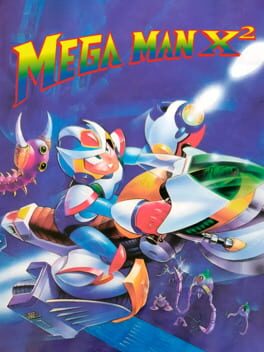 Mega Man X2 199485% alikeBoth plot-driven, earnest, grave.
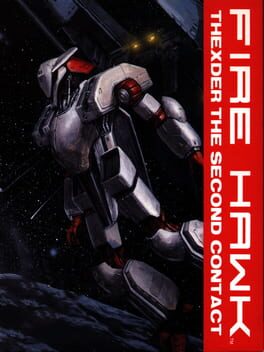 Both plot-driven, earnest, grave.
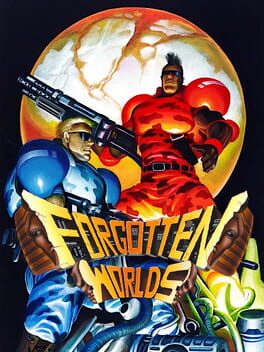 Forgotten Worlds 198884% alikeBoth plot-driven, earnest, grave.
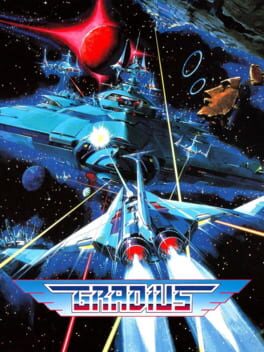 Gradius 198583% alikeBoth plot-driven, earnest, grave.
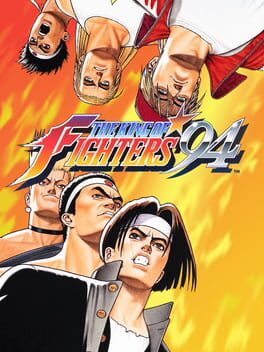 The King of Fighters '94 199483% alikeBoth earnest, plot-driven, classical in form.
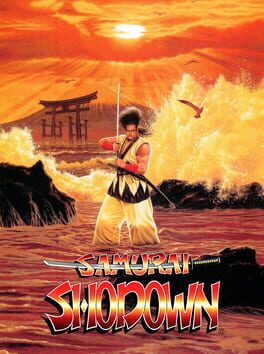 Samurai Shodown 199383% alikeBoth plot-driven, earnest, grave.
 Twin Hawk 198983% alikeBoth plot-driven, earnest, grave.
 Film · Both earnest, grave, cool.
 Flying Swords of Dragon Gate 201169% alikeFilm · Both earnest, grave, classical in form.
Often played with
Similar games per IGDB. Opening one adds it to Curator Co.