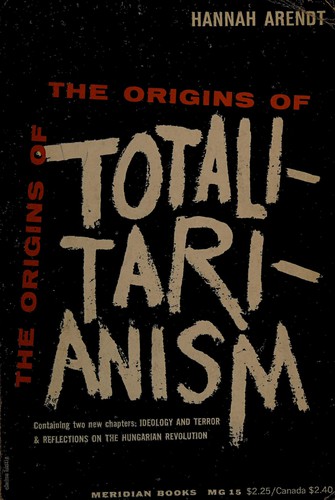
- Antisemitism, Imperialism, Totalitarianism, Philosophy, german
**Hannah Arendt's definitive work on totalitarianism and an essential component of any study of twentieth-century political history** The Origins of Totalitarianism begins with the rise of anti-Semitism in central and western Europe in the 1800s and continues with an examination of European colonial imperialism from 1884 to the outbreak of World War I. Arendt explores the institutions and operations of totalitarian movements, focusing on the two genuine forms of totalitarian government in her time—Nazi Germany and Stalinist Russia—which she adroitly recognizes were two sides of the same coin, rather than opposing philosophies of Right and Left. From this vantage point, she discusses the evolution of classes into masses, the role of propaganda in dealing with the nontotalitarian world, the use of terror, and the nature of isolation and loneliness as preconditions for total domination.
Log it
Sign in to log this.
Character
Earnest, grave, epic and classical in form.
- earnestironic
- gravecomic
- intimateepic
- classical in formformally daring
- cooloverwhelming
Who loves it, who doesn't
No profiled raters yet.
Ask the title
A yes-or-no question, answered from what people wrote here, on TMDB and on Wikipedia. Never made up.
Reviews
No reviews yet.
About the book
- Author
- Hannah Arendt
- First published
- January 1, 2003
- Pages
- 527
- Publisher
- Harcourt, Brace & World, Harcourt, Brace, Boom
- Editions
- 64
- Language
- French, German, Dutch, Arabic
- ISBN
- 9788690185924
Where to read
Libraries first: a card gets you most books for nothing. Each opens that service’s page for this title.
On Open Library, 14 have read it and 264 want to.
“acteristic of these times, when Jewish individuals and the first small wealthy Jewish communities were more powerful than at any time in the nineteenth century, was the frankness with which their privileged status and their right to it was discussed, and the careful testimony of the authorities to the importance of their services to the state. There was not the slightest doubt or ambiguity about the connection between services rendered and privileges granted.”
German-American philosopher and political theorist
Similar in taste
Closest on the same fourteen dimensions, from everything scored on Tastebuds Other media included when they land close.
 Leviathan 165174% alikeBoth earnest, grave, cool.
 Legacy of Ashes 200773% alikeBoth earnest, grave, classical in form.
 Both grave, earnest, classical in form.
 The Communist Manifesto 184869% alikeBoth earnest, grave, classical in form.
 Caliban and the Witch 200469% alikeBoth grave, earnest, epic; this one is more overwhelming.
 Eichmann in Jerusalem 196369% alikeBoth grave, earnest, classical in form; this one is more intimate.
 Discipline and Punish 197569% alikeBoth grave, earnest, cool.
 Both earnest, epic, classical in form.
 Carlos 201069% alikeFilm · Both grave, earnest, epic.
 Theatre Europe 198569% alikeGame · Both grave, earnest, epic.