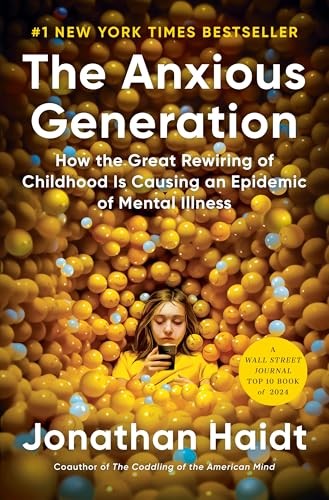
- Sociology, New York Times bestseller
After more than a decade of stability or improvement, the mental health of adolescents plunged in the early 2010s. Rates of depression, anxiety, self-harm, and suicide rose sharply, more than doubling on many measures. Why? In The Anxious Generation, social psychologist Jonathan Haidt (pronounced "height") lays out the facts about the epidemic of teen mental illness that hit many countries at the same time. He then investigates the nature of childhood, including why children need play and independent exploration to mature into competent, thriving adults. Haidt shows how the “play-based childhood” began to decline in the 1980s, and how it was finally wiped out by the arrival of the “phone-based childhood” in the early 2010s. He presents more than a dozen mechanisms by which this “great rewiring of childhood” has interfered with children’s social and neurological development, covering everything from sleep deprivation to attention fragmentation, addiction, loneliness, social contagion, social comparison, and perfectionism. He explains why social media damages girls more than boys and why boys have been withdrawing from the real world into the virtual world, with disastrous consequences for themselves, their families, and their societies. Most important, Haidt issues a clear call to action. He diagnoses the “collective action problems” that trap us, and then proposes four simple rules that might set us free. He describes steps that parents, teachers, schools, tech companies, and governments can take to end the epidemic of mental illness and restore a more humane childhood. Haidt has spent his career speaking truth backed by data in the most difficult landscapes—communities polarized by politics and religion, campuses battling culture wars, and now the public health emergency faced by Gen Z. We cannot afford to ignore his findings about protecting our children—and ourselves—from the psychological damage of a phone-based life.
- Suicide or self-harm
Log it
Sign in to log this.
Character
Earnest, classical in form, spare and contemporary.
- earnestironic
- classical in formformally daring
- sparerichly built
- contemporarynostalgic
- resolvedopen-ended
Who loves it, who doesn't
No profiled raters yet.
Ask the title
A yes-or-no question, answered from what people wrote here, on TMDB and on Wikipedia. Never made up.
Reviews
No reviews yet.
About the book
- Author
- Jonathan Haidt
- First published
- 2024
- Pages
- 395
- Publisher
- Rizzoli, Ten Have, Penguin Press
- Editions
- 7
- Language
- Dutch, English, Italian
- ISBN
- 9788817189767
Where to read
Libraries first: a card gets you most books for nothing. Each opens that service’s page for this title.
On Open Library, 13 have read it and 233 want to.
Jonathan David Haidt (/haɪt/; born October 19, 1963) is an American social psychologist, Professor of Ethical Leadership at New York University Stern School of Business,[1] and author. His main areas of study are the psychology of morality and moral emotions. Haidt's main scientific contributions come from the psychological field of moral foundations theory,[2] which attempts to explain the evolutionary origins of human moral reasoning on the basis of innate, gut feelings rather than logical reason.[3] The theory was later extended to explain the different moral reasoning and how they relate to political ideology, with different political orientations prioritizing different sets of morals.[4
Similar in taste
Closest on the same fourteen dimensions, from everything scored on Tastebuds Other media included when they land close.
 Invisible Women 201981% alikeBoth contemporary, earnest, spare.
 The God Delusion 200176% alikeBoth earnest, spare, classical in form.
 Never Split the Difference 201670% alikeBoth earnest, contemporary, classical in form.
 Bad Blood 201868% alikeBoth earnest, classical in form, contemporary.
 Why We Sleep 201761% alikeBoth earnest, classical in form, spare.
 Billy Summers 202159% alikeBoth classical in form, contemporary, earnest.
 A Promised Land 202058% alikeBoth earnest, classical in form, grave.
 Everything Is Tuberculosis 202557% alikeBoth earnest, contemporary, classical in form; this one is more character-led.
 Kiss the Ground 202077% alikeFilm · Both earnest, classical in form, contemporary.
 Life Story 201477% alikeTelevision · Both earnest, contemporary, spare.